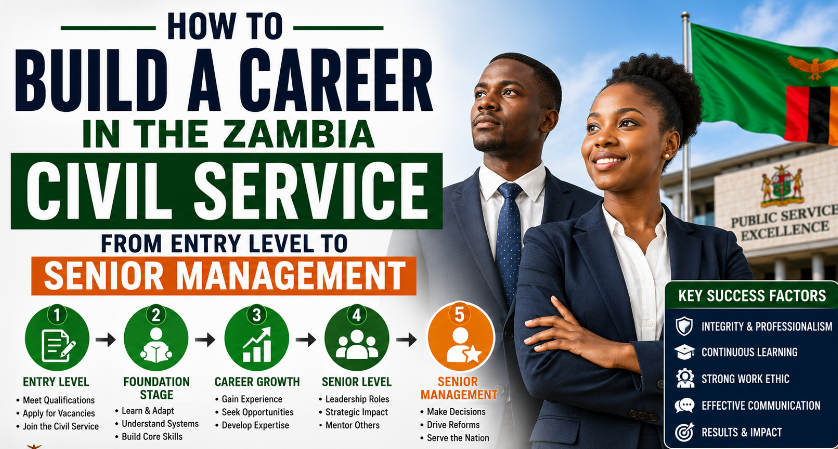
How to Build a Career in the Zambia Civil Service: Many Zambians enter the civil service and remain at the same grade for their entire career – not because they lack ability, but because they do not have a clear career development strategy. The civil service rewards those who are proactive, qualified, and strategically positioned for promotion.
This guide shows you how to build a genuinely successful long-term career in the Zambia Civil Service.
Stage 1: Getting In – Entry Level (Grades D5–D8)
Your career begins when you are first appointed to a civil service position. Most graduates enter at Grade D5 or D6, while diploma holders typically start at D7 or D8. At this stage, your priorities should be:
- Learn your role thoroughly and exceed expectations in your first performance appraisal
- Build relationships with your supervisors and senior colleagues
- Understand the structure, mandate, and culture of your ministry or department
- Keep all your appointment letters, confirmation letters, and performance appraisal records safely filed
Tip: Many civil servants are never confirmed in their positions because they do not follow up on their confirmation. After 12 months, write a formal letter to your supervisor requesting confirmation. This is your right.
Stage 2: Building Your Profile (Grades D3–D5)
After 3 to 5 years, you should be positioning yourself for your first promotion. To move up:
- Maintain consistently good performance appraisal ratings (Satisfactory or above)
- Volunteer for additional responsibilities and special assignments
- Pursue further studies – a bachelor’s degree, diploma, or professional qualification relevant to your field
- Attend all training courses and workshops your institution offers
- Develop a reputation for reliability, integrity, and professionalism
Stage 3: Middle Management (Grades S3–S4 / D1–D2)
At this stage, you are managing teams, coordinating projects, or running a unit. This is where many careers plateau. To break through to senior management:
- Complete a postgraduate qualification (Master’s degree or professional certification)
- Apply for secondments or attachments to other ministries, departments, or international organizations
- Build a professional network across different government institutions
- Demonstrate leadership during challenges – how you handle a crisis defines your reputation
- Engage with professional associations in your field
Stage 4: Senior Management (Grades S1–S2 / P3–P4)
Director, Deputy Director, Principal Officer – these are the positions that come with significant responsibility, respect, and remuneration. To reach this level:
- You will typically need at least 15–20 years of progressive experience
- A master’s degree or equivalent professional qualification is usually required
- You must have a strong track record across multiple roles and postings
- Political and institutional relationships matter at this level – build them ethically
- Consider serving on committees, boards, or task forces to raise your profile
Key Habits of Zambian Civil Servants Who Succeed
- They keep detailed records of all their work, achievements, and correspondence
- They treat every posting – including rural postings – as an opportunity to demonstrate capability
- They invest in their own professional development, even when the government does not sponsor them
- They maintain their integrity even under pressure – reputation is everything in a small system
- They mentor junior staff, which builds goodwill and leadership credentials
Final Thought
A career in the Zambia Civil Service is a marathon, not a sprint. The most successful civil servants are those who combine patience with continuous self-improvement, strategic relationship-building, and an unwavering commitment to excellence in their work.
Follow recruitmentvila.com for career development guides, government recruitment news, and the latest shortlisted candidates updates across all Zambia government institutions.